
Quinoa--An Impressive Seed
As research and new articles continue to emerge, those who want to make good dietary changes, take notice. When new information about what to eat and what to avoid surfaces, one considers changes in the diet and sometimes lifestyle. In talking with individuals desiring to make changes, one common concern seems universal. It’s where to start.
Are you one that purchases something new at the grocery store, bring it home, place it in the cabinet and never even open it? Too many times I’ve talked to people who have great intentions on using this new “healthy” product, but it comes down to not really feeling confident in how to prepare it. Just like many areas in life, cooking is a risk. There is a real risk that what you will prepare will fail in some way. It may not taste good, the consistency will be off, or it will be too labor intensive.
This article will focus on quinoa as it seems to be an illusive “super grain” that people get excited about, but rarely use. When I ask people if they use quinoa, I get a sheepish yes. When I ask how they use it, the response is: “I haven’t even opened it yet. I’m not sure what to do with it.” My goal in this moment is to empower you to use your quinoa or any other grain that’s been taking up space in your cabinet.
If quinoa (pronounced KEEN-wah) is new to you, let me tell you about this wonderful seed. While many people call quinoa a grain, it’s actually a seed that needs high elevation to grow properly. Quinoa, during the Inca Empire, was an important crop that was believed to be sacred and called the “mother of all grains.” It has been eaten for thousands of years in South American but has only recently become popular in the United States. Now, quinoa can be found in health food stores and restaurants all over the world.
Quinoa is available in three main types: white, red, and black. The nutrient components of one cup of cooked quinoa is:
· Protein: 8 grams.
· Fiber: 5 grams.
· Manganese: 58% of the recommended daily allowance (RDA).
· Magnesium: 30% of the RDA.
· Phosphorus: 28% of the RDA.
· Folate: 19% of the RDA.
· Copper: 18% of the RDA.
· Iron: 15% of the RDA.
· Zinc: 13% of the RDA.
· Potassium 9% of the RDA.
· Over 10% of the RDA for vitamins B1, B2 and B6
· Small amounts of calcium, B3 (niacin) and vitamin E.
As you can see there is a big payoff when choosing to use this ingredient. Now let’s discuss how to use it and where to use it. Personally, I like to have my quinoa talk back to me. I enjoy a little crunch and not a mushy porridge. With that said, for every 1 cup of quinoa, I use 1 ½ cups water. It doesn’t take long to cook. Place both water and quinoa in a pot and bring to a boil. Once it boils, lower temperature and simmer until most of the liquid is absorbed. Remove from the heat and allow to rest until all liquid is absorbed. From here you can cool and use in salads or add to other ingredients (many are here on this website.)
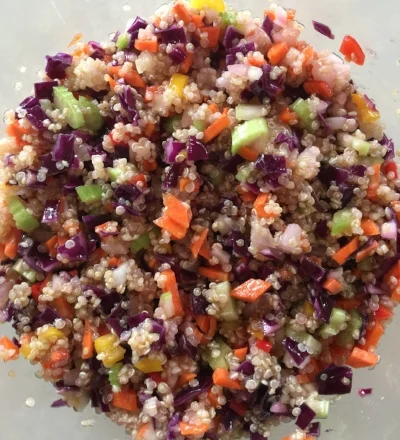
Below is a salad I threw together quickly when I was invited to a pot luck. Thankfully, I had some vegetables in my refrigerator and before I knew it, I had a salad that was colorful and delicious. Quinoa is wonderful to add to soups as well. I encourage to you be creative and let me know what inspires you. Quinoa is very versatile and has a slight nutty flavor. It has limitless potential and should be a staple in your diet.
COLORFUL QUINOA SALAD
Ingredients
· 1 ½ cup cooked quinoa
· ½ cup purple cabbage, chopped
· ½ cup bell pepper, diced
· ½ cup scallions
· ½ cup carrots, diced
· ½ cup celery, sliced
· ¼ cup extra virgin olive oil
· 3 TBSP Ume plum vinegar
Mix all ingredients together. Chill and serve.
Health bite: Face your fear of using quinoa!
